Modern buildings are constantly evolving. From rooftop solar installations and HVAC upgrades to building extensions, communications equipment and EV charging infrastructure, organisations are continually adapting their estates to meet changing operational and sustainability requirements. However, while buildings change, the protection systems designed to safeguard them often remain largely unchanged.
As buildings become more complex, maintaining compliance with standards such as BS EN IEC 62305 for lightning protection and BS 8610 for anchor systems requires organisations to consider how modifications affect existing protection measures. Increasingly, compliance is about understanding how risks evolve throughout a building’s lifecycle rather than simply meeting requirements at handover.
To explore the risks this can create, Nick Marshall, Managing Director at Omega Red Group, sat down with members of Omega Red’s compliance and inspection team to discuss why building modifications should prompt a review of lightning protection and height safety systems.
Buildings change more frequently than many organisations realise
A key theme throughout the discussion was the pace at which buildings evolve. Roof spaces are becoming increasingly complex, with solar PV systems, air handling units, communications equipment and other assets regularly added long after a building has been commissioned.
As Kane Taylor, Compliance Operations Manager, explains: “People go to buildings, they have works done, they’ll have different assets installed. Anything on a roof that changes or is installed is a potential where there could be a risk.”
While individual projects may be assessed in isolation, the cumulative impact of multiple modifications is often overlooked. This can create a disconnect between a building’s current configuration and the assumptions made during the original design risk assessment. Significant changes to a building’s structure, use or rooftop layout may therefore warrant a reassessment of existing protection measures.
Modifications can affect lightning protection performance
One of the most common misconceptions discussed by the panel was that a lightning protection system will continue to perform as intended regardless of changes made to the building.
As Chris Harrison, Senior Business Development Manager, highlighted: “If someone’s building an extension onto a building, that’s going to change the fundamental way the system actually works.”
Lightning protection systems are designed around a building’s dimensions, occupancy, use and risk profile. Extensions, rooftop plant and renewable energy installations can all affect those original design assumptions. Organisations should consider whether existing air termination, down conductor, earthing, bonding and surge protection arrangements remain appropriate as buildings evolve.
This is particularly relevant where solar PV, battery storage systems and EV charging infrastructure have been introduced, as these can create additional pathways for surge energy to enter a building. Without review, a series of small changes can gradually reduce the effectiveness of existing protection measures.
Height safety should be part of the conversation
The panel emphasised that building modifications do not only affect lightning protection. Changes to a roof can also create new challenges for those responsible for maintaining and accessing equipment safely.
Kane noted: “If they’ve put a new unit on the roof, are people getting there safely? How will they work with this equipment safely?”
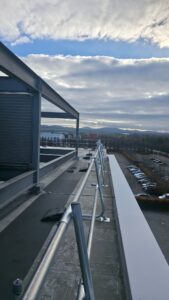
Height safety systems should be reviewed whenever works affect access routes, work areas or maintenance requirements. Anchor systems, lifelines and safe access equipment should be considered as part of the wider project, not after installation has been completed.
Drawing on inspection experience, Lee Bisby, Business Development Manager, shared examples ranging from new rooftop equipment being installed without suitable access provisions, to safety systems that had been altered during later refurbishment works. In some cases, safe access equipment remained on site but no longer aligned with the building’s layout or maintenance requirements. These examples highlight how easily rooftop risks can be introduced when protection systems are not reviewed alongside wider building modifications.
The biggest risks are often hidden from view
Many protection system issues are not immediately visible.
Reflecting on common inspection findings, Chris commented: “Quite often it’s bonds. Bonds to new plant that’s not been installed.” Referring to the metallic connections used to ensure equipment remains at the same electrical potential as the wider system.
Similarly, Lee described a project where roofing works had inadvertently compromised an existing safety system: “The roofers had undone the system. So, at the other end it was just not attached to anything.”
These examples illustrate how modifications carried out over many years can affect performance unless they are properly documented, reviewed and incorporated into maintenance programmes. Without accurate asset registers and periodic inspections, issues can remain hidden until maintenance work, an audit or an incident brings them to light.
Compliance is a continual process
Perhaps the strongest message from the panel was that compliance should never be viewed as a one-off exercise.
As Chris explained: “People have got a certificate on file, they believe that the system is therefore perfectly safe to use and it’ll be indefinitely perfectly safe to use. And that’s not the case.”
Supporting this point, Office Manager Laura O’Reilly added: “Compliance isn’t a piece of paper.”
Inspection certificates provide evidence that a system met the relevant standard at the time of testing. They cannot account for future modifications, changes in building use or the installation of new assets.
For organisations looking to improve resilience, best practice is to review protection systems, risk assessments, maintenance schedules and asset registers whenever significant works are completed.
Looking beyond compliance
Reflecting on the discussion, Nick believes the industry’s challenge is not simply maintaining compliance but ensuring protection systems remain aligned with the realities of modern buildings.
Whether it’s a building extension, rooftop solar installation, new plant equipment or a change in building use, every modification has the potential to affect existing protection measures. Organisations that integrate protection system reviews into refurbishment, expansion and upgrade projects will be better positioned to maintain compliance, reduce risk and support long-term operational resilience.
As buildings continue to evolve, the most resilient organisations will be those that treat protection systems as living assets rather than fixed installations. By reviewing lightning protection and height safety arrangements whenever significant changes occur, businesses can help ensure their people, assets and operations remain protected long after the original construction project has been completed.
Whether you’re planning an extension, installing rooftop equipment, adding solar PV or upgrading site infrastructure, Omega Red’s specialists can help assess whether your lightning protection and height safety systems remain fit for purpose.
Want to hear more from the panel?
Hear the full discussion in our latest Grounded in Safety podcast episode, where Nick and the panel explore compliance in action, share industry experiences and discuss what effective risk management looks like in practice.
Listen on your favourite streaming platform:
Youtube: https://lnkd.in/ect8z7w3
Spotify: https://lnkd.in/em3Da6sX
Apple Podcasts: https://lnkd.in/erdDDmJi